Disposable Vape vs Pod System: 12 Technical Differences Explained
Understanding the difference between a disposable vape and a pod system requires examining their internal construction, battery technology, heating elements and cartridge architecture.
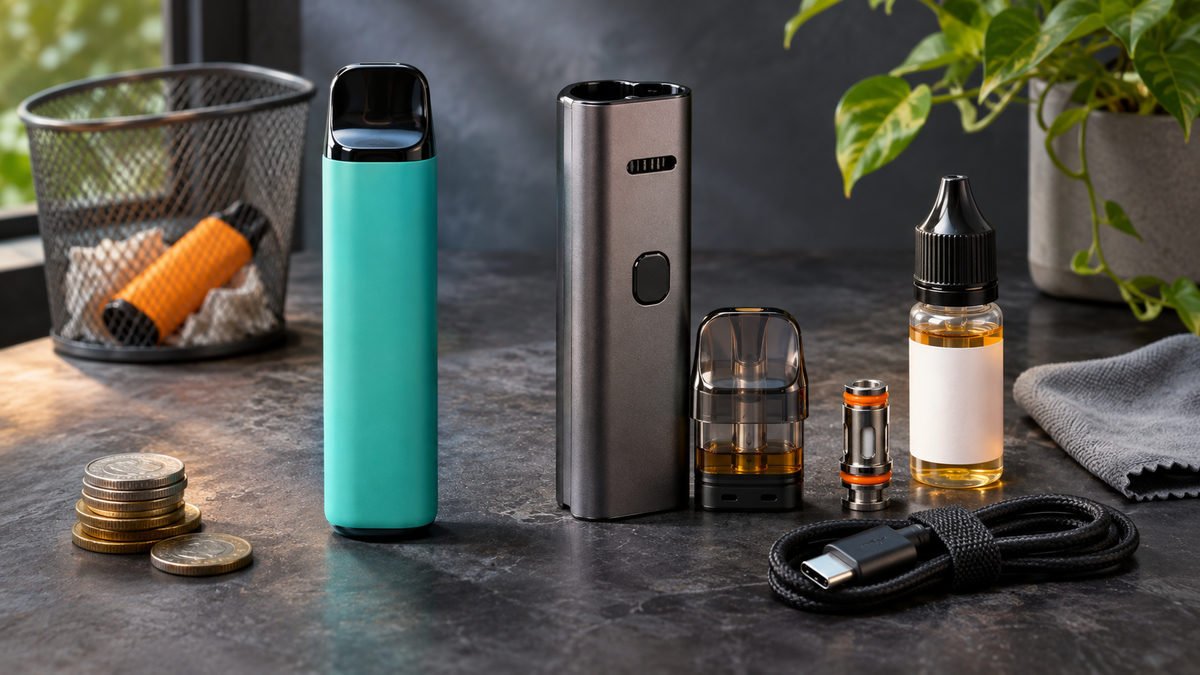
Although both formats may have similar external dimensions, they operate through different component configurations.
This technical guide compares disposable vapes, prefilled closed pod systems and refillable open pod systems.
1. What Is a Disposable Vape?
A disposable vape is an integrated electronic device containing several components within one housing.
These generally include a battery, liquid reservoir, heating coil, wick, sensor, control circuit, airflow channel and mouthpiece.
When the liquid is exhausted or the device stops functioning, the complete unit is generally discarded.
Its construction prioritises a simple operating arrangement with minimal routine maintenance.
2. What Is a Pod System?
A pod system separates the main electronic body from the liquid-containing cartridge.
There are two common configurations.
Closed Pod System: Uses factory-filled cartridges that are replaced when empty.
Open Pod System: Uses refillable cartridges that accept compatible e-liquid.
Both configurations generally retain the rechargeable battery body across multiple cartridge replacements.
3. Disposable Vape vs Pod System: Technical Comparison
| Feature | Disposable | Closed Pod | Open Pod |
|---|---|---|---|
| Construction | Integrated | Reusable body | Reusable body |
| Cartridge | Built-in | Factory-filled | Refillable |
| Battery | Fixed | Rechargeable | Rechargeable |
| Charging | None or limited | Regular | Regular |
| Coil options | Limited | Model-dependent | Often broader |
| Airflow | Usually fixed | Fixed or limited | Often adjustable |
| Maintenance | Minimal | Basic | More involved |
| Reusability | Limited | Battery body reusable | Battery body reusable |
Individual specifications vary by manufacturer and model.
4. How Do Disposable Vapes and Pod Systems Work?
Most compact vaping devices use a similar operating principle.
When a user inhales, a pressure sensor detects a change in the airflow channel.
The control circuit activates the heating element, which transfers heat to the liquid supplied by the wick.
The resulting aerosol travels through the internal passage toward the mouthpiece.
The main architectural difference is how the battery, reservoir and coil are packaged and replaced.
5. Battery Capacity and Charging
Battery capacity is commonly expressed in mAh.
A larger capacity generally indicates greater stored electrical charge under comparable conditions.
However, actual operating duration also depends on power consumption, resistance, activation time and circuit efficiency.
Traditional disposables may use non-rechargeable batteries, while rechargeable disposables allow charging of the existing battery.
Pod systems generally use rechargeable batteries designed for repeated charging cycles.
A USB-C connector alone does not establish charging speed or support for use while charging.
6. Coil Resistance and Mesh Technology
Coil resistance is measured in ohms.
It affects electrical current and interacts with operating voltage to determine heating power.
Mesh coils use a metal sheet or mesh structure to provide a larger heating surface.
Conventional coils use wound resistance wire.
The heating configuration influences thermal behaviour, aerosol production and liquid consumption.
7. Airflow Design Differences
Disposable devices commonly use fixed airflow pathways.
Some pod systems include adjustable airflow controls.
Airflow influences pressure drop, cooling and aerosol transportation.
A tighter airflow pathway generally creates greater draw resistance under comparable conditions.
However, the final result also depends on coil design and electrical power.
8. E-Liquid and Cartridge Compatibility
Disposable devices generally contain a fixed liquid volume and formulation.
Closed pods use compatible factory-filled cartridges.
Open pods allow refilling with separately purchased e-liquid.
Liquid viscosity and PG/VG composition can affect wick saturation and cartridge performance.
Using unsuitable liquid can contribute to leakage, flooding or inadequate liquid delivery.
9. Why Advertised Puff Counts Vary
Advertised puff counts are estimates based on particular testing conditions.
Actual draw counts depend on:
Draw duration
Inhalation strength
Battery condition
Coil resistance
Operating wattage
Airflow
Liquid availability
Cutoff duration
Longer activations generally consume more liquid and electrical energy.
For this reason, advertised puff counts are not guaranteed real-world results.
10. Maintenance and Common Technical Problems
Disposable devices require relatively little routine maintenance.
Pod systems require additional attention to charging, cartridge connections and cleaning.
Common technical issues include:
Leakage
Condensation
Blocked airflow
Burnt coil material
Battery degradation
Worn electrical contacts
Improper cartridge installation
Reusable components can be replaced individually, but additional connections may create more potential failure points.
11. Ownership Cost and Environmental Impact
A meaningful cost comparison should include all components used during the same period.
For disposable devices, the complete unit is generally replaced.
Closed pod systems require replacement factory-filled cartridges.
Open pod systems require refill liquid and potentially replacement pods or coils.
Reusable battery bodies may reduce the number of complete devices discarded.
However, all formats generate some form of electronic or packaging waste.
Lithium-powered devices should be disposed of through appropriate local collection facilities.
12. Battery and Electrical Safety
Both disposable and pod devices may contain lithium-ion batteries.
Relevant electrical risks include short circuits, excessive heat, damaged cells and unsuitable charging equipment.
Protective circuits may include overcharge, over-discharge and short-circuit protection.
These features reduce certain risks but cannot guarantee that a device will never fail.
Damaged, swollen or unusually hot devices should not continue to be used.
Frequently Asked Questions
What is the main difference between a disposable vape and a pod system?
A disposable integrates most components into one unit, while a pod system separates the reusable battery body from the liquid cartridge.
What is a closed pod system?
A closed pod system uses factory-filled cartridges that can be replaced while retaining the main battery body.
What is an open pod system?
An open pod system uses refillable cartridges, allowing compatible liquid to be added separately.
Is a rechargeable disposable the same as a pod system?
No. Charging a disposable does not make it reusable if its liquid reservoir and internal components are not designed for replacement or maintenance.
Do pod systems have adjustable airflow?
Some models do, particularly certain open pod systems. However, airflow functionality depends on the specific design.
Do disposable vapes use mesh coils?
Some models use mesh heating elements, while others use different coil configurations.
Does battery capacity determine device performance?
No. Capacity describes stored charge, while operating power depends on voltage, resistance and the control circuit.
Why do advertised puff counts differ from actual use?
Draw duration, power, airflow, liquid consumption and battery condition all influence the final count.
Are refillable pods completely waste-free?
No. They still generate waste through cartridges, coils, liquid bottles, packaging and eventual battery replacement.
Which system has more maintenance requirements?
Refillable open pod systems generally require more routine attention than integrated disposable devices.
Conclusion
Disposable vapes, closed pod systems and refillable pod systems have different technical architectures.
Their differences involve battery reuse, cartridge design, coil options, airflow control, maintenance, recurring costs and waste generation.
Comparing actual specifications is more informative than relying on category names or advertised puff counts.
A complete technical assessment should include battery capacity, power regulation, coil compatibility, liquid capacity, charging specifications and disposal requirements.
Original Source:
Disposable Vape vs Pod System: Technical Differences
This article provides technical and educational information only. It does not constitute medical advice or a recommendation to use vaping products.


Comments
Post a Comment