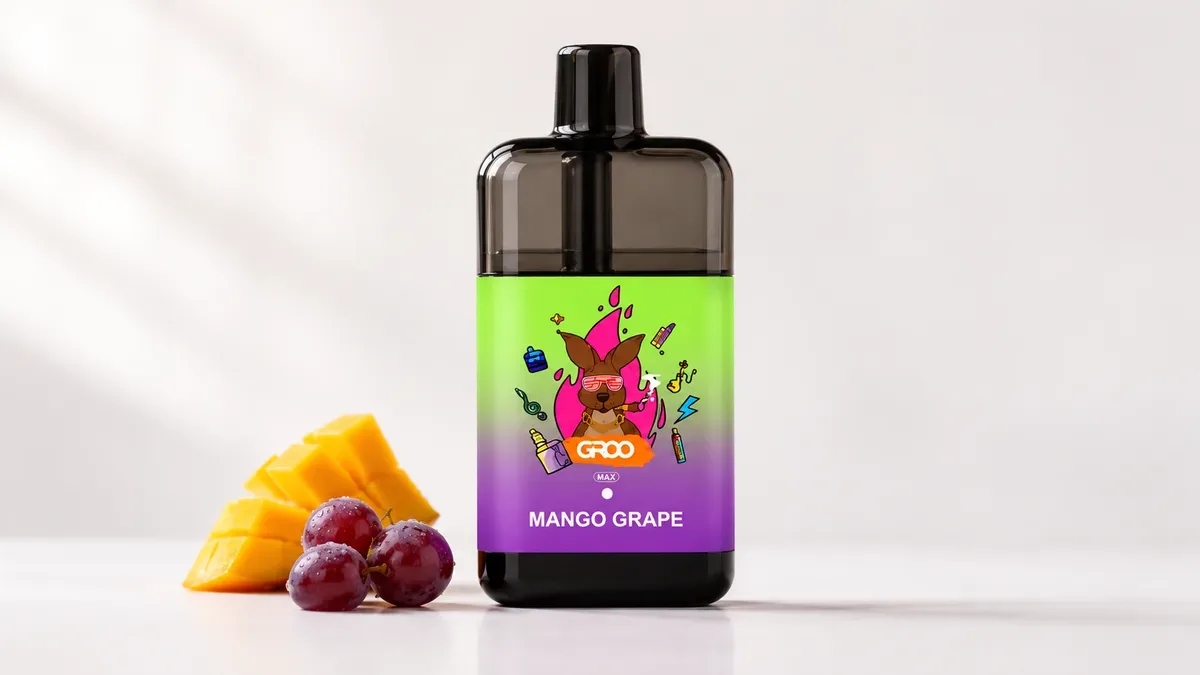
GROO Max 10000 Puffs Mango Grape: Understanding Flavour Labelling and Product Information
Understanding vape flavour labelling involves distinguishing commercial descriptions from measurable scientific properties.
Fruit-based terminology and numerical performance statements may appear prominently on packaging, but neither independently establishes chemical composition or health safety.
This educational guide examines the scientific and public health considerations associated with interpreting such information.
1. Understanding Different Types of Product Information
Product labels may contain several categories of information.
| Information Category | General Meaning |
|---|---|
| Model name | Product identification |
| Flavour name | Descriptive terminology |
| Ingredient statement | Declared chemical composition |
| Nicotine concentration | Chemical concentration |
| Puff figure | Performance statement |
| Warning statement | Risk communication |
Each category serves a different purpose and requires appropriate interpretation.
2. Why Fruit Names Are Not Ingredient Declarations
Fruit terminology can communicate a sensory association without describing the underlying chemical formulation.
Establishing whether a particular ingredient is present requires appropriate documentation or scientific analysis.
The name of a food should not be interpreted as evidence of nutritional value or suitability for inhalation.
3. Sensory Characteristics and Scientific Measurements
Human sensory perception involves complex biological processes.
Terms describing sweetness, acidity or aroma may reflect subjective impressions rather than standardised measurements.
Scientific assessment requires defined testing procedures.
For example, perceived sourness cannot independently establish a formulation's pH value.
Similarly, a recognisable aroma cannot establish the identity of every chemical compound present.
4. Understanding Advertised Puff Counts
A numerical performance claim should be considered within its original testing context.
Without access to the measurement methodology, the number cannot establish a guaranteed operating duration.
Scientific interpretation requires distinguishing an advertised estimate from independently verified results.
Performance figures also provide insufficient information to determine biological exposure.
5. Nicotine Concentration and Total Content
Nicotine-related measurements describe different chemical properties.
| Measurement | Meaning |
|---|---|
| mg | Mass of a substance |
| mg/mL | Mass relative to liquid volume |
| Percentage | Proportion under a defined measurement convention |
| Total content | Overall quantity present |
| Absorbed dose | Quantity entering the body |
These measurements should not be treated as interchangeable.
A commercial description cannot establish nicotine concentration or absorbed dose.
6. Understanding Incomplete Ingredient Information
Ingredient statements may vary in their level of detail.
A broad description does not necessarily identify every individual compound within a formulation.
Missing information creates uncertainty rather than proof that a substance is absent.
Reliable scientific communication requires acknowledging these limitations.
7. Product Documentation and Information Accuracy
Scientific and consumer safety assessments depend on accurate records.
Differences between packaging and accompanying documentation may indicate unresolved identification or labelling issues.
Conflicting information should be documented and referred to an appropriate responsible authority.
Unverified details should not be presented as established facts.
8. Packaging and Regulatory Requirements
Different jurisdictions regulate product presentation in different ways.
Regulatory requirements may address chemical information, warning statements, product design and legal availability.
Visual appearance cannot establish compliance with these requirements.
For Australian regulatory information, consult the Therapeutic Goods Administration directly.
9. Understanding Nicotine-Related Health Risks
Nicotine is an addictive substance that can cause acute poisoning.
Potential symptoms of significant exposure include:
Nausea and vomiting
Dizziness
Excessive sweating
Trembling
Changes in heart rate
Confusion
Serious symptoms, including seizures or breathing difficulties, require emergency medical assistance.
In Australia, suspected poisoning should be referred promptly to the Poisons Information Centre on 13 11 26. For life-threatening emergencies, call 000.
10. Battery Safety and Electrical Hazards
Compact electronic products containing lithium-ion batteries may present electrical and thermal hazards.
Physical damage, abnormal heating and internal electrical faults can compromise battery stability.
Equipment showing swelling, smoke, leakage or unexpected activation should be taken out of service.
Do not dismantle, puncture or attempt to recharge damaged lithium-ion equipment.
11. Environmental Impact and Electronic Waste
Electronic vaping devices may contain several materials requiring specialised waste management.
These include electrical circuits, plastics, metals, batteries and residual chemical substances.
Improper waste handling can expose collection workers and the environment to additional hazards.
Local waste authorities can provide information about appropriate collection arrangements.
Frequently Asked Questions
Does a mango or grape flavour name establish real fruit content?
No. Chemical composition requires supporting ingredient information.
Can a fruit-based description establish nutritional benefits?
No. Familiar food terminology does not establish nutritional value or health safety.
Does a puff count indicate nicotine exposure?
No. Performance statements and biological exposure are separate measurements.
Does missing nicotine information mean a product is nicotine-free?
No. An absent declaration should be treated as unresolved information.
Can packaging appearance establish regulatory compliance?
No. Regulatory compliance requires assessment against applicable official requirements.
Are familiar flavour names evidence of reduced health risks?
No. Health risks cannot be determined from flavour terminology.
Can damaged lithium-ion devices present fire hazards?
Yes. Battery damage can cause serious electrical and thermal failures.
How should discarded electronic vaping devices be handled?
Contact the relevant local waste authority for appropriate electronic-waste or hazardous-waste collection arrangements.
Conclusion
Understanding flavour labelling requires separating descriptive language, chemical information and performance statements.
Product terminology cannot independently establish ingredients, nicotine concentration, electrical safety or regulatory compliance.
Evidence-based interpretation, poison prevention and responsible waste management remain important elements of consumer and public health education.
Original Educational Article:
GROO Max 10000 Puffs Mango Grape – Vape Labelling Guide
Australian Regulatory Resource:
This article provides general educational information and does not constitute medical advice or a recommendation to use vaping products.


Comments
Post a Comment