Understanding Nicotine Concentration Labels: A Guide to Measurement Units and Safety
Understanding nicotine concentration labels involves identifying measurement units, reference quantities and the distinction between chemical content and biological exposure.
Different nicotine-containing products may use similar numbers to represent different properties.
This educational guide explains common terminology and important safety considerations.
1. What Is Nicotine Concentration?
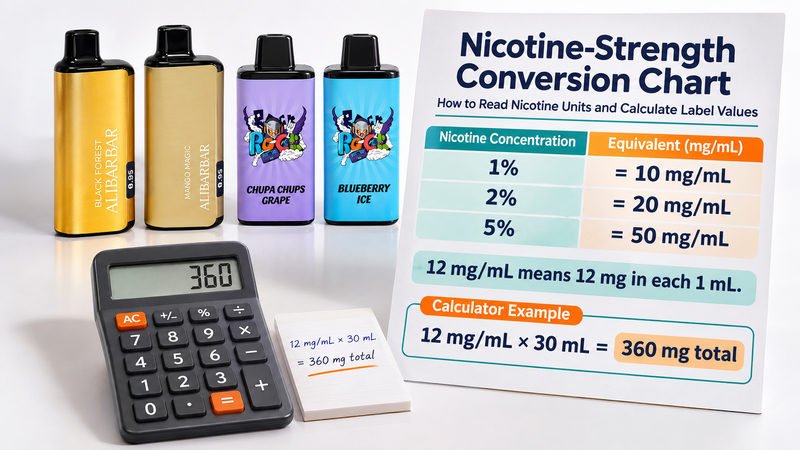
Concentration describes the quantity of nicotine relative to a specified amount of material.
It is different from the total nicotine present in a package and the amount ultimately absorbed by the body.
These distinctions are essential for interpreting scientific measurements accurately.
2. Common Nicotine Measurement Units
| Unit | Measurement Meaning |
|---|---|
| mg | Mass |
| mg/mL | Mass relative to liquid volume |
| mg/g | Mass relative to product mass |
| Percentage | Proportion under a specified convention |
| mg per unit | Mass associated with an individual portion |
| mg per stated period | Quantity associated with a specified time interval |
The complete measurement must include its reference quantity.
3. Understanding Percentage-Based Labels
Percentage measurements can follow different scientific conventions.
A mass-to-volume percentage describes a different relationship from a mass-to-mass percentage.
Product information should identify which convention applies.
Without this context, converting a percentage into another unit may produce inaccurate results.
4. Nicotine Content vs Absorbed Dose
The amount of a substance contained within a product does not necessarily equal the amount entering the body.
Several distinct concepts are relevant:
Content: The quantity physically present.
Concentration: The quantity relative to a specified reference amount.
Delivery: The amount released by a product.
Absorption: The amount entering the body.
Exposure: Contact with a substance across a particular route and duration.
These concepts should remain separate when discussing nicotine-related risks.
5. Total Content and Individual Portions
Packaging may include several numerical statements.
One figure might describe concentration, while another represents the contents of an individual portion or the entire package.
Confusing these values can lead to substantial misunderstandings.
This is particularly important when evaluating accidental ingestion or exposure.
6. Why Absorption Rates Differ
Biological absorption depends on multiple factors, including the route of exposure, duration, formulation and individual characteristics.
The amount printed on a label cannot independently predict these processes.
Healthcare professionals consider additional information when assessing nicotine exposure or prescribing appropriate cessation treatment.
7. Understanding Label Accuracy
Reliable scientific communication requires clear identification of the measured substance and its reference quantity.
Useful documentation may include:
Complete measurement units
Ingredient declarations
Package identification
Manufacturer information
Relevant safety warnings
Ambiguous or conflicting information should be treated as uncertain.
8. Misleading Nicotine Claims
Some descriptions use subjective words rather than measurable chemical quantities.
| Description | Important Limitation |
|---|---|
| Mild | No universal numerical definition |
| Smooth | Does not establish reduced exposure |
| Light | Does not demonstrate lower health risk |
| Tobacco-free | Does not necessarily mean nicotine-free |
| Extra strong | Requires supporting numerical context |
Descriptive terminology should not replace verified chemical information.
9. Recognising Nicotine Poisoning
Nicotine poisoning can occur through ingestion, inhalation or significant skin exposure.
Possible symptoms include nausea, vomiting, abdominal discomfort, dizziness, sweating, trembling and changes in heart rate.
More serious warning signs include breathing difficulty, seizures, fainting and loss of consciousness.
Suspected poisoning requires prompt professional assessment.
Do not induce vomiting unless specifically instructed by a medical professional.
10. Nicotine Poisoning Assistance in Australia
For suspected poisoning in Australia, contact the Poisons Information Centre on 13 11 26.
For severe symptoms or a life-threatening emergency, call 000.
Keep the relevant packaging available so medical professionals can identify the substance involved.
11. Safe Storage and Disposal
Nicotine-containing substances should be stored securely away from children and pets.
Keep products in their original identified containers.
Avoid transferring chemical substances into food or beverage containers.
Used nicotine-containing products may retain residual substances and should be disposed of according to applicable local requirements.
Frequently Asked Questions
What does mg/mL mean?
It represents milligrams of a substance per millilitre of liquid.
What does mg/g mean?
It represents milligrams of a substance per gram of material.
Is nicotine concentration the same as total nicotine content?
No. Concentration describes a relative quantity, whereas total content describes an overall amount.
Does labelled nicotine content equal absorbed nicotine?
No. Biological absorption depends on additional factors that cannot be determined from the printed number alone.
Are nicotine percentage measurements always identical?
No. Their interpretation depends on the measurement convention used.
Does a mild description establish lower nicotine exposure?
No. Subjective descriptions are not standardised scientific measurements.
Does tobacco-free mean nicotine-free?
Not necessarily. A product can contain nicotine without containing tobacco leaf material.
Can nicotine poisoning be dangerous?
Yes. Significant nicotine exposure can cause serious and potentially life-threatening poisoning.
Can used nicotine products still contain nicotine?
Yes. Residual nicotine may remain after use.
Where can someone obtain professional help with nicotine dependence?
A qualified healthcare professional or pharmacist can provide appropriate guidance on smoking cessation and nicotine replacement therapy.
Conclusion
Understanding nicotine labels requires more than recognising a printed number.
Measurement units, reference quantities and exposure mechanisms must be interpreted separately.
Clear scientific terminology helps prevent misleading comparisons and supports awareness of nicotine-related health risks.
Safe storage, responsible disposal and timely medical assistance remain essential considerations.
Original Educational Article:
Understanding Nicotine Concentration Labels Clearly
Additional Australian Public Health Resource:
https://www.healthdirect.gov.au/
This article provides general educational information and does not constitute professional medical advice.


Comments
Post a Comment