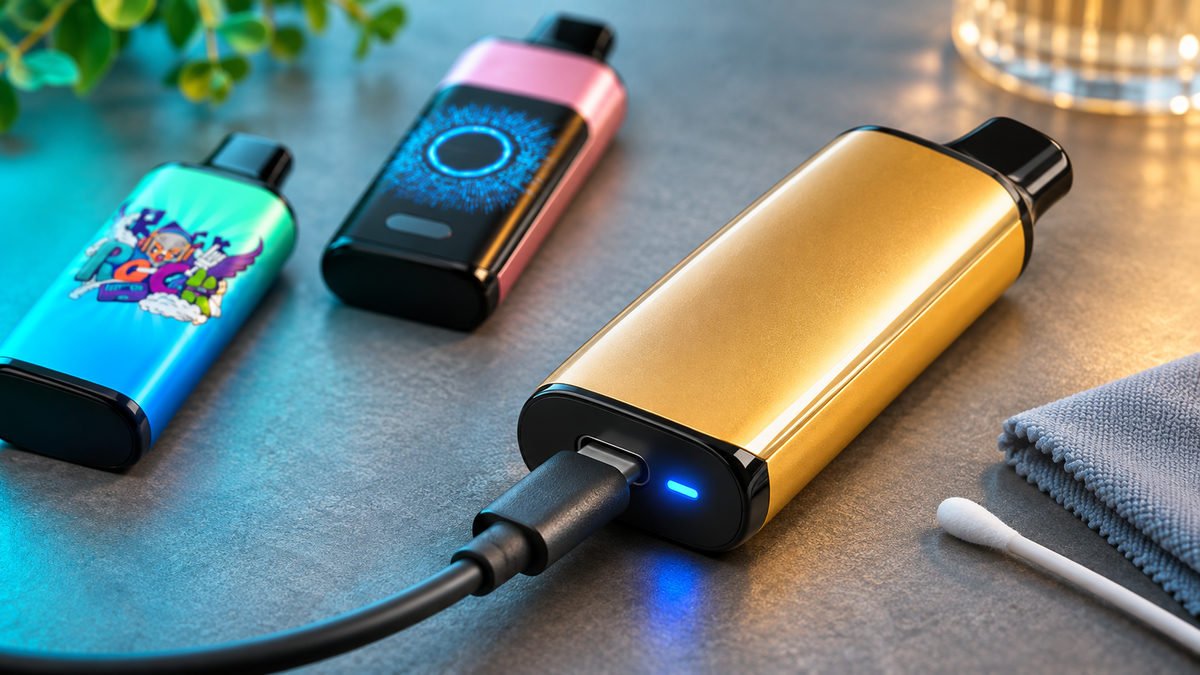
USB-C Charging Technology in Vape Devices: Complete Technical and Battery Safety Guide
Understanding USB-C charging technology in vape devices requires examining more than the physical connection.
Charging behaviour depends on electrical input, internal control circuits, battery chemistry and thermal conditions.
This educational guide explains the fundamental engineering principles behind USB-C charging and the associated electrical safety considerations.
1. What Is USB-C Charging Technology?
USB-C is a standardised physical connector used across many electronic device categories.
Its symmetrical construction allows the connector to be inserted in either orientation.
However, the connector itself does not establish:
Supported voltage
Maximum electrical current
Charging speed
Power Delivery compatibility
Battery protection capabilities
These characteristics depend on the complete electrical system.
2. How USB-C Charging Systems Work
Rechargeable devices rely on several interconnected components to regulate electrical energy.
| Component | General Function |
|---|---|
| USB-C connector | Establishes the physical power connection |
| Charging controller | Manages electrical energy transfer |
| Protection circuit | Responds to abnormal electrical conditions |
| Temperature monitoring | Helps identify excessive thermal conditions |
| Lithium-ion battery | Stores electrical energy |
The exact implementation varies between electronic devices.
3. Understanding Voltage, Current and Wattage
Electrical charging systems involve three fundamental measurements.
| Measurement | Unit | Meaning |
|---|---|---|
| Voltage | V | Electrical potential difference |
| Current | A | Rate of electrical charge movement |
| Power | W | Rate of energy transfer |
| Battery capacity | mAh | Stored electrical charge under specified conditions |
Electrical power can be expressed using the relationship:
Power = Voltage × Current
These measurements describe different physical properties and should not be confused.
4. USB-C vs Micro-USB Charging
USB-C and Micro-USB differ in their mechanical configuration and supported technical standards.
| Feature | USB-C | Micro-USB |
|---|---|---|
| Connector orientation | Reversible | Directional |
| Physical shape | Symmetrical | Asymmetrical |
| Charging speed | Implementation-dependent | Implementation-dependent |
| Electrical compatibility | Specification-dependent | Specification-dependent |
| Mechanical durability | Construction-dependent | Construction-dependent |
Connector type alone cannot establish electrical performance or safety.
5. What Is USB Power Delivery?
USB Power Delivery, commonly abbreviated as USB-PD, is a protocol that supports electrical power negotiation between compatible equipment.
A device may have a USB-C interface without implementing advanced Power Delivery functionality.
Therefore, the presence of a USB-C port should not be interpreted as proof of fast-charging support.
Electrical compatibility must be established through the relevant technical documentation.
6. What Determines Charging Speed?
Charging duration depends on interactions between the battery and its electrical control system.
Relevant variables include battery capacity, electrical input limits, thermal conditions, battery condition and energy-transfer efficiency.
The electrical controller may also change its behaviour throughout the charging process.
Advertised charging times should therefore be interpreted within their stated testing conditions.
7. Understanding Lithium-Ion Battery Charging
Lithium-ion batteries require controlled electrical charging.
The control circuitry monitors relevant conditions and regulates the transfer of electrical energy.
Charging behaviour may change as the battery approaches full capacity.
Temperature and battery condition can also influence how the controller operates.
A damaged or degraded battery may no longer behave as originally intended.
8. Battery Protection Circuitry
Rechargeable electronic equipment may incorporate several protective functions.
| Protection Function | Intended Purpose |
|---|---|
| Overvoltage protection | Limits exposure to excessive voltage |
| Overcurrent protection | Responds to excessive electrical current |
| Short-circuit protection | Interrupts abnormal electrical pathways |
| Thermal protection | Responds to excessive temperature |
| Charging cutoff | Limits charging beyond defined conditions |
Protective functions vary by design and cannot eliminate every failure scenario.
9. Why Lithium-Ion Batteries Degrade
Battery aging occurs through chemical and physical changes within rechargeable cells.
Factors associated with degradation include:
Repeated charging and discharging
Elevated temperatures
Physical damage
Extended storage under unsuitable conditions
Natural chemical aging
As batteries degrade, their usable capacity and electrical behaviour may change.
A visibly damaged battery should never be treated as a normal consequence of aging.
10. Understanding Charging Indicators
Electronic equipment may use lights, displays or other indicators to communicate charging status.
Indicator colours and flashing patterns are not universal.
A signal may represent charging activity, completion or an electrical fault, depending on the device.
Manufacturer documentation provides the appropriate interpretation.
An indicator alone cannot establish that a damaged battery is safe.
11. Electrical Safety Warning Signs
Lithium-ion battery failures can present serious hazards.
Important warning signs include unusual heat, swelling, leakage, corrosion, burning smells and abnormal electrical behaviour.
If equipment appears damaged:
Stop using it.
Avoid additional charging attempts.
Do not dismantle or puncture the battery.
Disconnect electrical power only when safe.
Follow appropriate professional safety and disposal guidance.
If a battery is smoking or burning, move away and contact emergency services.
12. Responsible Battery and Electronic-Waste Disposal
Electronic products containing lithium-ion batteries require appropriate waste handling.
Improper disposal can create fire hazards in collection vehicles and waste-processing facilities.
Vaping devices may also contain residual substances requiring additional handling precautions.
Contact local electronic-waste or battery collection services to confirm whether they accept these products.
Frequently Asked Questions
Does USB-C always support fast charging?
No. Charging performance depends on the electrical implementation and supported communication protocols.
Is USB-C the same as USB Power Delivery?
No. USB-C is a physical interface, while USB Power Delivery is a power-negotiation protocol.
Does battery capacity determine charging speed?
Not independently. Charging duration also depends on internal electrical limits, battery condition and temperature.
What is a charging controller?
A charging controller is an electronic component or circuit that manages energy transfer into a rechargeable battery.
Do protective circuits prevent every battery failure?
No. Protective systems reduce certain risks but cannot guarantee complete safety.
Why do rechargeable batteries become less effective over time?
Chemical aging, repeated operation and environmental conditions contribute to battery degradation.
Are charging indicator colours universal?
No. Indicator behaviour depends on the manufacturer's implementation.
Is a swollen lithium-ion battery safe?
No. Swelling is a serious warning sign, and the affected equipment should not continue to be used or charged.
Can sealed rechargeable batteries be dismantled safely at home?
No. Opening or modifying sealed lithium-ion cells can create serious electrical, chemical and fire hazards.
Can lithium-ion devices be placed in ordinary household waste?
They should generally be handled through appropriate battery or electronic-waste collection services, following local requirements.
Conclusion
USB-C charging technology involves a combination of connector design, electrical control, communication protocols and rechargeable battery management.
The physical connector does not independently determine charging speed, compatibility or electrical safety.
Understanding battery degradation, protective circuitry and warning signs is essential when evaluating rechargeable electronic equipment.
Damaged lithium-ion devices should be removed from service and handled through appropriate disposal channels.
Original Educational Source:
USB-C Charging Technology in Vape Devices: Complete Guide
This article provides general technical and electrical safety information. It does not constitute medical advice or a recommendation to use vaping products.


Comments
Post a Comment