Vape Puff Count Explained: Why Advertised Numbers Differ from Actual Use
Understanding vape puff counts requires more than reading the number printed on a product package.
A device advertised with thousands of puffs may provide fewer usable draws under everyday conditions.
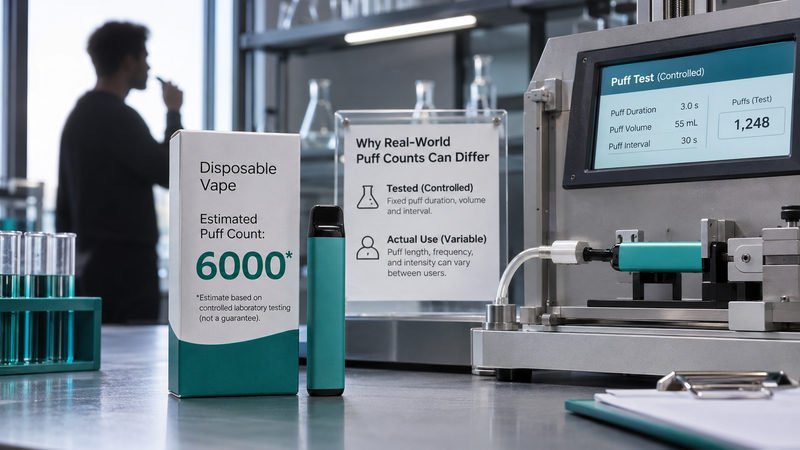
This happens because advertised puff counts generally represent estimates rather than guaranteed performance.
What Is a Vape Puff Count?
A vape puff count is an estimated number of device activations or draws under specified conditions.
Manufacturers may use laboratory equipment to simulate inhalations.
Testing methods can control draw duration, airflow and the time between activations.
However, there is no single universal testing method used by every manufacturer.
Why Do Advertised Puff Counts Differ from Actual Use?
Several factors can affect the achievable number of puffs.
Draw Duration
Longer draws keep the heating element active for more time.
This can increase battery demand and e-liquid consumption.
Puff Frequency
Frequent activations with short intervals may increase heat buildup and affect liquid delivery.
Battery Capacity
A battery must provide enough electrical energy to operate the heating element throughout the device's usable life.
E-Liquid Capacity
Liquid volume helps determine the available supply, but not all remaining liquid may reach the coil.
Coil and Airflow Design
Coil resistance, wattage, airflow and wick efficiency influence aerosol production.
Storage Conditions
Extreme temperatures, leakage and long storage periods may affect device performance.
Advertised Puff Count vs Actual Puff Count
| Factor | Laboratory Testing | Real-World Use |
|---|---|---|
| Draw duration | Often fixed | Variable |
| Airflow | Controlled | Depends on user and device |
| Puff interval | Standardised | Irregular |
| Temperature | Often controlled | Changes with environment |
| Device performance | Measured under selected conditions | Can vary over time |
| Final puff total | Estimated | Depends on multiple factors |
How to Calculate Estimated Vape Lifespan
A simplified formula is:
Estimated Days = Realistic Usable Puffs ÷ Daily Puffs
Example:
If a device provides an estimated 2,400 usable activations and an individual averages 160 per day:
2,400 ÷ 160 = 15 days.
However, this calculation is illustrative.
It does not account precisely for differences in draw duration, heating efficiency or battery performance.
Why Battery and E-Liquid Capacity Matter
Battery capacity and liquid volume are related but separate technical specifications.
A device may stop operating when its battery reaches a protective cutoff, even if some liquid remains.
Alternatively, the liquid may become depleted while battery charge is still available.
This is one reason puff count should not be evaluated independently of device specifications.
Are Built-In Puff Counters Accurate?
Electronic puff counters may help record activation frequency, but they are not precision measurement instruments.
Some devices count very short activations.
Others may record interrupted draws or accidental triggers.
Counters also do not necessarily measure the duration or intensity of each inhalation.
What Can Reduce Usable Puff Counts?
Several technical problems may affect usable output:
E-liquid leakage
Condensation in airflow passages
Incomplete wick saturation
Battery voltage decline
Coil residue buildup
Sensor malfunction
Extreme storage temperatures
Persistent burnt flavour, overheating, swelling or physical damage should be treated as warning signs.
Users should not dismantle or modify disposable devices to recover remaining liquid.
Frequently Asked Questions
What does 10,000 puffs mean on a vape?
It generally represents an advertised estimate based on a manufacturer's selected testing conditions, not a guaranteed number of usable draws.
Why might a vape stop working before reaching its advertised puff count?
Possible reasons include longer draws, frequent activations, insufficient battery energy, liquid-delivery problems or component variation.
Does a higher puff count mean a better device?
Not necessarily. Puff counts alone do not establish product quality, safety or consistent performance.
Does puff duration affect e-liquid consumption?
Yes. Longer heating periods can increase liquid consumption, although the relationship is not always directly proportional.
Can two identical devices have different puff counts?
Yes. Manufacturing tolerances, storage conditions and operating patterns can produce different results.
Can a puff counter measure nicotine intake?
No. Puff counters do not directly measure nicotine concentration, aerosol delivery or nicotine absorption.
Does rechargeable mean unlimited puffs?
No. Recharging can restore battery energy, but it does not replenish e-liquid or repair worn components.
Conclusion
Advertised vape puff counts should be understood as estimates rather than exact performance guarantees.
Draw duration, frequency, battery capacity, e-liquid volume, heating technology and storage conditions all contribute to real-world differences.
Clear testing information and transparent technical specifications are more informative than relying on the largest advertised number alone.
Original Source:
Why Advertised Puff Counts May Differ from Actual Use
Educational information only. Vaping products are not risk-free and may contain addictive nicotine.


Comments
Post a Comment